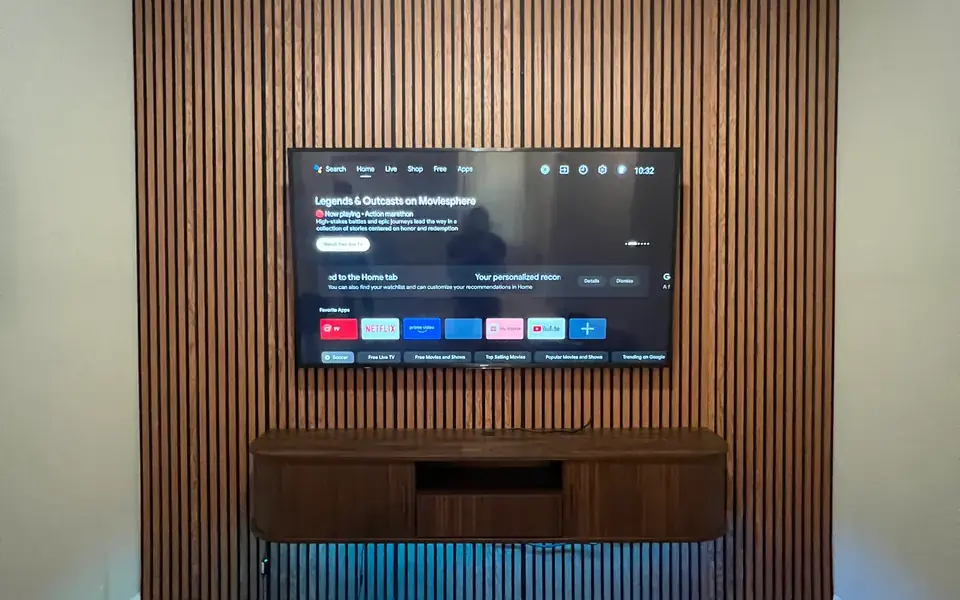
The right mount depends on where the seats are and how high the TV ends up, not on which one has the longest feature list. A wall straight in front of the sofa at eye level takes a fixed mount for $49. A screen that ends up above eye level, over a mantel or a dresser, takes a tilting mount for $59. A room where the TV has to be seen from two places, or from an angle, takes a full-motion mount for $79. Each is a line on the prices page added to the labor price for the screen size, and a mount you already own goes up for nothing extra. Here is how to choose by room.
Fixed: flat, close and at eye level
A fixed mount is two rails on the TV that hook over a plate on the wall. The screen hangs an inch or two off the drywall and does not move. It is the thinnest of the three, and on a wall painted one color the TV looks as if it were set into it.
It suits one situation very well: the wall directly in front of the seating, with the center of the screen at about eye level when you sit. A living room with the sofa facing a blank wall, a bedroom where the TV faces the bed from the same height, a den with one row of seats. If that is your room, there is no reason to pay for movement you will never use.
Two things to know before you choose it. First, once the TV is up there is almost no room behind it. Plugging in a new cable means lifting the TV off the plate, so decide on the cables first: leave them, a cover for $49, or the in-wall route for $99. Second, it has no angle. If the screen ends up higher than your eyes, you will watch it with your chin up, and that is the case for the next mount.
A 32-inch TV on a fixed mount, drywall, wires showing, is $178. A 24-inch TV on the same mount is $118.
Tilting: a few degrees down from above a mantel
A tilting mount holds the TV close to the wall but lets the top lean out so the screen faces down a few degrees. That is all it does, and it is enough for a great many rooms.
The usual case is a TV that has to hang above something. Above a fireplace, the mantel sets the lowest point, so the screen sits higher than you would like. Above a dresser in a bedroom, the same. Above a tall console, a bar, a counter, or in any room where you watch lying back, the tilt brings the picture down to your eyes and cuts the glare from a window or a lamp across the room.
The screen still sits close to the wall, a little further out than on a fixed mount so the top can lean. Reaching behind it is easier, because you can tilt it forward to get at the ports. The mount is $59, and a 55-inch TV on one over drywall with the wires left showing is $188.
Full motion: an arm for a corner or a second seat
A full-motion mount has an arm that folds flat against the wall, pulls out a foot or more, and turns left and right. With the arm out, the TV can face a different part of the room than the wall it hangs on.
It earns its $79 in rooms where one position cannot serve everyone. A corner, where the TV hangs on one wall but faces the diagonal. A kitchen, where the screen has to be seen from the stove and from the table. A great room with seating on two sides, a sofa facing the wall and a counter off to one side. A bedroom where the TV is watched from the bed and from a chair by the window. In each of those, the arm swings the screen to where you are and folds back when you are done.
It asks more of the wall. With the arm out, the TV’s weight hangs a foot or more from the plate, and that pulls on the top bolts far harder than a flat plate does. A full-motion mount is fastened into solid framing, which often means a plate that spans two studs rather than one. On a hard wall it goes into masonry anchors, the kind made for brick or concrete, and the hard-wall line adds $59. A 65-inch TV on a full-motion mount on brick, wires showing, is $303. More on hard walls is on the brick and stone page.
Bringing your own mount
If you already have a mount, it goes up with no extra charge. Three things to check before the visit so the job is not held up.
The VESA pattern. On the back of the TV are four threaded holes in a rectangle. The distance between them, in millimeters, is printed in the TV’s manual and on the mount’s box. The mount’s plate or arms have to reach those holes. Most mounts cover a range of patterns, but a small mount meant for a monitor will not reach the holes on a 65-inch screen.
The weight rating. Every mount lists a maximum weight. Compare it to the TV’s weight without its stand, from the manual or the spec sheet. A margin is better than a match.
The hardware. The box should have the wall plate, the rails or arms, the lag bolts for the wall and a bag of screws in several sizes for the TV. Missing lag bolts are the common gap. If some are gone, say so when you book, and the technician brings them.
The technician will decline a mount in one case: a bracket too light for the screen, whether by weight or by size range. A 55-inch TV on a mount you already have, drywall, wires showing, is $129. That number is the labor for the size alone.
Screen size and the mount
The mount prices are the same for every TV size, so the choice above does not change with the screen. What changes is the labor. Up to 31 inches is $69, 32 to 59 inches is $129, and a TV of 60 inches and up is $165 with one technician and your help lifting, or $210 with two technicians and nothing for you to carry. That holds whatever the mount, and whatever the size past 60. Details are on the large TV page.
A large screen on a full-motion arm is the heaviest case for the wall, and the technician checks the stud layout before drilling. If the studs do not fall where the plate needs them, a wider plate or a shift of a few inches usually solves it.
Two kinds of mount are not on the list. A ceiling mount, which drops the TV from above on a pole, and a motorized mount, which lowers or swings on a remote, are priced from a photo. Text a photo of the wall and the TV’s size to (404) 448-1471 and a price comes back.
Questions
Can a tilting mount turn the TV sideways?
No. A tilting mount leans the top of the screen out, nothing more. If you need the screen to face a seat off to the side, that is a full-motion mount at $79. Choosing tilting to save money and then finding the angle wrong is the one mistake worth avoiding here.
Does a full-motion mount sag over time?
A mount rated for the TV and fastened into solid framing holds its position. Sagging comes from an arm loaded past its rating or bolts set in drywall alone. Both are checked at the install, and the mount is load-tested before the TV goes on it.
Should the TV sit higher so a tilting mount can be used?
No. Lower is better, and the tilt is there to fix a height you cannot change, not to excuse one you can. In a room with no mantel or furniture in the way, put the center of the screen at seated eye level and use a fixed mount.
Is a mount included in the labor price?
No. The labor price covers the install, and the mount is added only if you need one: $49 fixed, $59 tilting or $79 full motion. Bring your own and that line disappears. Other answers about walls, wires and the visit are on the FAQ page.
Tell us the room and where the seats are, and we will say which mount it takes. Call or text (404) 448-1471, add up your total on the prices page, or pick a time.
Related articles
How to Get an Exact TV Mounting Price by Text: the Photo, the Size and the ZIP
Oct 30, 2026
Hidden TV Wires: How In-Wall Power Works and What the $99 and $149 Lines Cover
Oct 30, 2026
Mounting More Than One TV: How the 20% and 30% Discounts Work and How to Plan the Visit
Oct 30, 2026