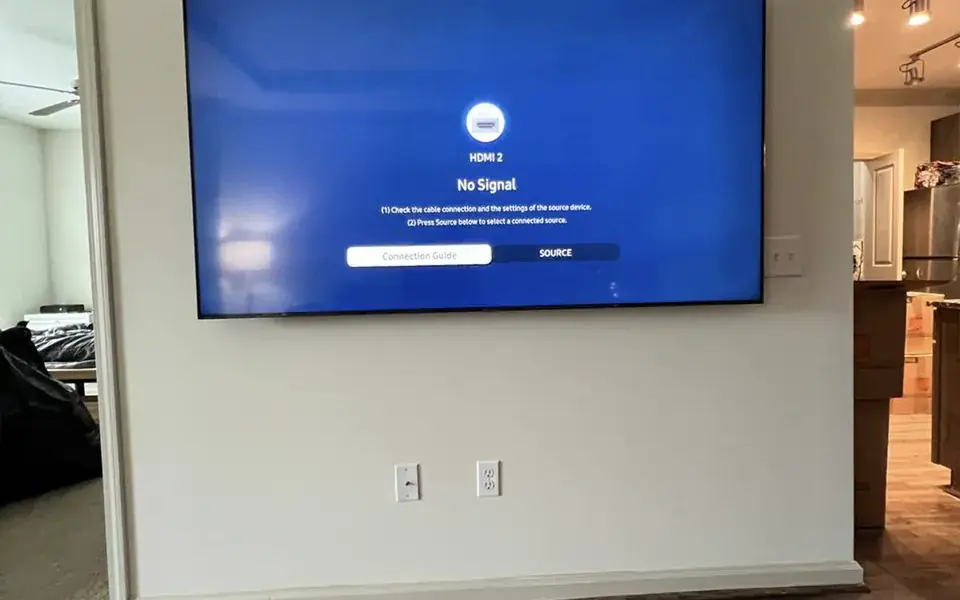
Hidden TV wires mean two things on a job: the signal cables pass inside the wall between two plates, and the TV gets its own outlet behind it, fed through a cable made for in-wall use. That is the $99 line on drywall, or $149 when the TV hangs above a fireplace. If the wall cannot be opened, or you would rather it stayed closed, a paintable cover on the wall for $49 does the same work on the surface. This guide covers what goes inside the wall, what never does, what the technician checks before cutting, and why a fireplace wall costs more.
Three ways to handle the cables
Every mounted TV has at least a power cord, and most have an HDMI cable or two heading to a streaming box, a game console or a soundbar. You can do three things with them.
Leave them. The cables hang from the bottom of the screen to the outlet, bundled neatly, and nothing is added to the bill.
Put them in a cover. A slim channel is fixed to the wall from the TV down to the outlet, the cables go inside, and the lid snaps on. It takes paint, so it can match the wall. That is $49 per TV.
Put them in the wall. The cables go in behind the TV and come out low, near the outlet or the console, so nothing runs down the face of the wall. This line includes the power outlet behind the TV and is $99, or $149 above a fireplace. The wire concealment page lists all three next to the mount prices.
The totals add up per TV on the prices page. A 55-inch TV on drywall with a fixed mount is $227 with the cables in a cover, $277 with them in the wall, and $287 on a tilting mount with them in the wall. A 65-inch TV on a fixed mount with a soundbar under it and every cable in the wall is $392, and the soundbar installation page explains how its cable shares the route. Wires for a TV that is already on the wall are priced from a photo, because the mount, the cables and the wall behind the screen differ in every house.
What goes inside the wall
Two kinds of cable need to get from the TV to the gear below it, and they are treated differently.
Low-voltage cables are the HDMI, optical audio and ethernet lines. They carry signal, not house current, and they are the ones that pass straight through the wall. The technician cuts an opening behind the TV and a second one near the floor, fits a low-voltage plate in each, and feeds the cables through the stud bay between them. The plates have a brush or an open face, so a cable with a plug on it passes through without being cut.
Power is handled differently. The TV’s own cord never goes into the wall. Instead, a recessed in-wall power kit is fitted: a box with an outlet sits in the wall behind the TV, and a second box with an inlet sits in the lower opening. The two are joined inside the wall by a cable made for in-wall use. A short cord runs from the inlet to the existing outlet in the room, and the TV plugs into the outlet behind it. From the sofa, you see a TV with no cords and an ordinary plug low on the wall.
Why a plain extension cord never goes in the wall
People ask whether the technician can just push an extension cord or a power strip through the drywall and skip the kit. The answer is no, and the reasons are plain.
An extension cord is made to lie out in the open, where it stays cool and where you can see it. Inside a wall it sits in a closed space next to insulation and wood, a cord that warms up has nowhere to shed that heat, and nobody can look at it. A nick in the jacket from a screw or a rough edge of drywall stays out of sight for years. A power strip adds a row of plugs and a switch to a space that was never meant to hold them.
The in-wall power kit is made for this place. Its cable is rated for the inside of a wall, its connections sit in boxes, and both ends can be reached and checked. That is why the outlet is part of the $99 line rather than an option.
What the technician checks first
Before any opening is cut, the technician works out what is behind the drywall.
The studs come first. Their positions set where the mount goes and which stud bay the cables drop through. Both openings have to sit in the same bay, or the cable has to cross a stud, which is a different job.
Fire blocking is next. Many walls have a horizontal piece of wood partway up between the studs. If a block sits between the TV and the lower opening, the route may need a different bay or a small extra opening to pass it.
Insulation changes the feed. An exterior wall is usually full of it, and pulling cable through insulation takes longer than dropping it through an empty interior wall.
Then the technician looks for anything else in the bay: existing wiring, a plumbing line, a duct or a return-air cavity. The lower opening is placed to avoid them, and the nearest existing outlet decides where the inlet goes. Text a photo of the wall and the TV’s size to (404) 448-1471, and most of this is settled before the visit.
Why a fireplace wall is its own line
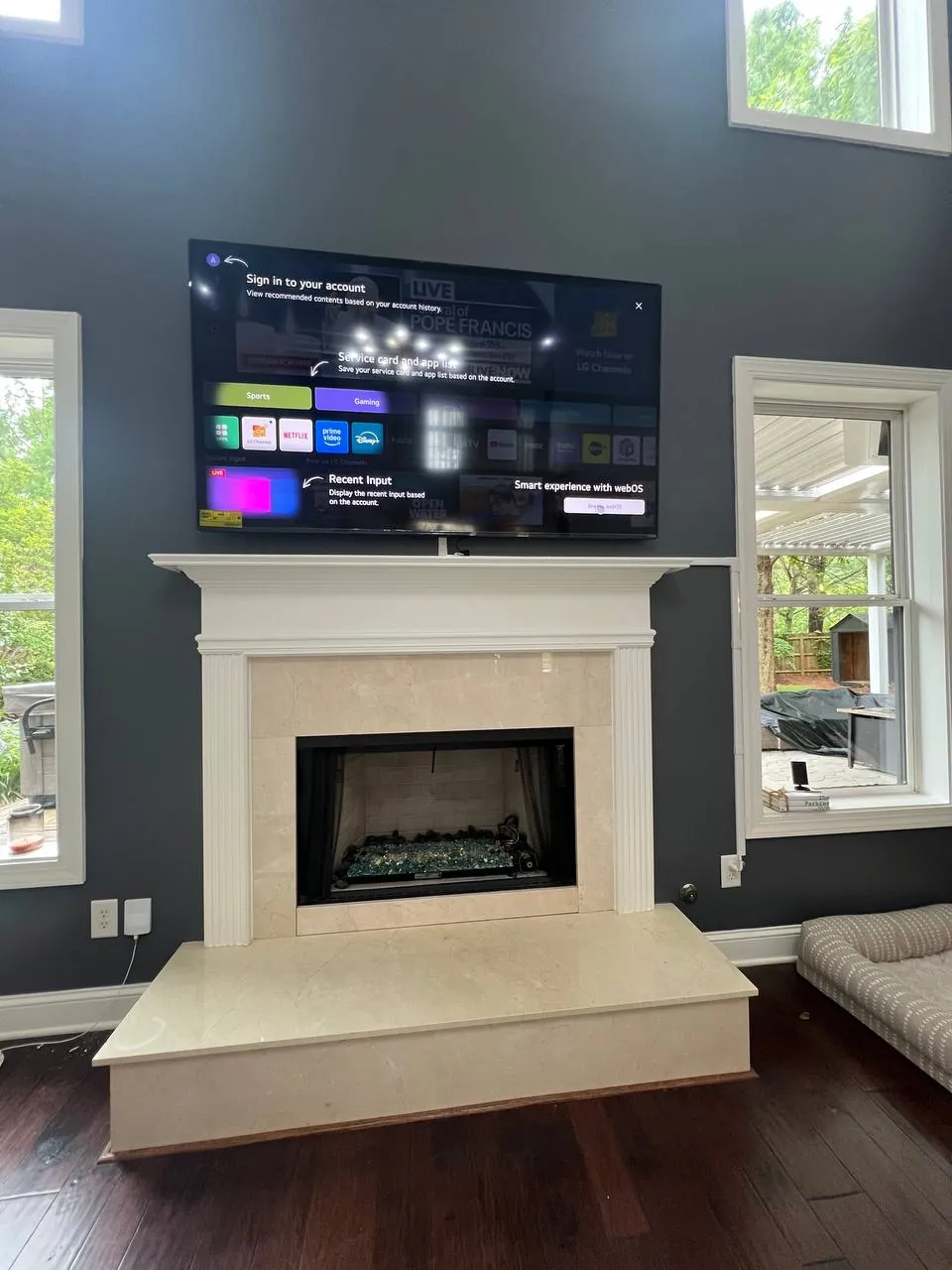
Above a fireplace, the path from the TV to the floor runs into the firebox. Wood-burning, gas insert or electric, there is a box where the stud bay would be, with a header over it carrying the weight of the wall above. Some also have a chimney chase, a framed column rising from the firebox through the ceiling, with framing of its own behind the TV.
So the cables rarely go straight down. The technician finds a route sideways through the wall above the mantel to a side wall or a bay beside the surround, then down to an outlet there. It means more openings, more time and sometimes a longer cable, which is why the in-wall line above a fireplace is $149 rather than $99. The height and the lift are covered on the fireplace mounting page, and mounting above a fireplace is its own $49 line. A 65-inch TV on a tilting mount above a drywall fireplace, with the cables inside the wall and an outlet behind the TV, comes to $422.
Walls where in-wall is not possible
Cables drop through a wall only when there is an open cavity behind its face. Solid brick and poured concrete have none. Concrete block with furring strips has a gap behind the drywall, but it is usually less than an inch, too shallow for the boxes of a power kit. Plaster applied straight onto masonry, common in older buildings, has no cavity at all.
On these walls the cover is the answer. It runs down the face from the TV to the outlet, holds every cable, and takes paint. It is $49 whatever the wall, and the masonry itself adds $59 for the anchors that hold the mount. A wall that looks like drywall sometimes turns out to be block behind a thin skin, so send a photo if you are unsure.
Questions
Does the house’s wiring change?
No. The recessed power kit plugs into the existing outlet in the room through its inlet, so nothing in the house’s wiring is touched. If there is no outlet within reach of the lower opening, say so before the visit.
Can I add a cable after the job?
Yes. The low-voltage plates stay open, so a new HDMI cable can be pushed in at the lower plate and fished out behind the TV. Ask for a pull string in the wall if you expect to add more later.
What if the TV is above a fireplace on brick?
The in-wall route is only possible where the wall above the mantel is framed and hollow. On a brick or stone surround, the cover is used instead for $49, and the masonry adds $59 for anchors. On a surround that is drywall over framing with brick only on the lower part, the $149 route often works. A photo settles it.
Will the cover show?
Less than you expect. It is a narrow channel, and once painted it reads as a line between the screen and the outlet. On a patterned or textured wall, the in-wall route is the cleaner choice if the wall allows it.
Call or text (404) 448-1471 with the TV’s size and a photo of the wall, or build your own total on the prices page and pick a time.
Related articles
Fixed, Tilting or Full Motion: Which $49, $59 or $79 Mount Fits Your Room
Oct 30, 2026
How to Get an Exact TV Mounting Price by Text: the Photo, the Size and the ZIP
Oct 30, 2026
Mounting More Than One TV: How the 20% and 30% Discounts Work and How to Plan the Visit
Oct 30, 2026