TV wire concealment
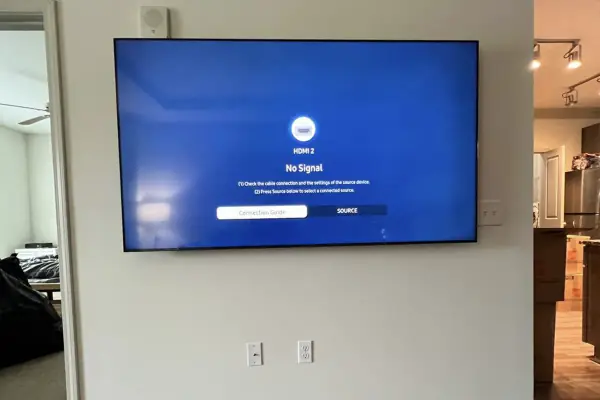
A TV on the wall with cords hanging down to the outlet still looks half done. When we mount your TV, the cables can go one of two ways: a paintable cover running down the wall ($49), or a route inside the wall that comes with a power outlet behind the TV ($99, or $149 above a fireplace). If the TV is already mounted, we price the wire work from a photo.
Your price, step by step
Request a time
By providing a telephone number and submitting the form, you are consenting to be contacted by SMS text message and agreeing to our Privacy Policy. Message frequency may vary. Message and data rates may apply. Reply STOP to opt out of further messaging. Reply HELP for more information.
A cover on the wall, or the cables inside it
Behind most mounted TVs there's a power cord and usually an HDMI cable or two, plus whatever a soundbar or cable box adds. Left alone, they hang from the bottom of the screen to the outlet and the console. There are two ways to deal with them, and each is a line on the same per-TV price list as the mount.
Option one is a cord cover: a slim, paintable channel fixed to the wall, running between the TV and the outlet below it with the cables tucked inside. It sits on the surface, so the wall itself isn't opened, and it can be painted the same color as the wall. That's $49.
Option two puts the cables in the wall. They go in behind the TV and come back out low, near the outlet or the media console, so nothing runs down the wall in between. This option includes a power outlet behind the TV and is $99, or $149 when the TV hangs above a fireplace.
For a 55-inch TV, the numbers work out like this. A fixed mount with the cables in a cover is $227: $129 for the size, $49 for the mount and $49 for the cover. Put the cables in the wall instead and the same job is $277. With a tilting mount and the in-wall route, it's $287. Every line is on the prices page.
Already have the TV on the wall and only want the wires handled? That job isn't on the menu; a photo sets its price, as explained further down.
Paintable cord cover
$49. A low-profile channel from the TV to the outlet that can take the wall color, with no openings cut.
Cables inside the wall
$99, with a power outlet behind the TV. Nothing shows between the screen and the console under it.
Over a fireplace
$149 for the in-wall route above a mantel. The wall over a firebox is built differently, so it has its own price.
Already-mounted TVs
Wires on a TV that's already up are priced from a photo. Text it to (404) 448-1471.
Which option suits your wall?
A cover is the usual answer in three cases. Many leases don't allow opening a wall, and a cover stays on the surface; ask your landlord either way, since the mount itself needs holes. Solid brick and stone have no hollow space behind the face for cables to drop through. And plaster, the original wall in many older houses, from the Victorians of Raleigh's Oakwood to the 1920s bungalows of Tampa's Seminole Heights, is harder to cut cleanly than drywall, so we check a photo before saying the in-wall route will work there.
The in-wall route suits drywall over wood studs, where there's usually open space between the studs for the cables to pass down. It's the one to pick if you want the TV to look as if it simply hangs there, with no line running down from it. If you can't tell what your wall is made of, a photo usually settles it.
Why the in-wall option includes an outlet
The cord that comes with a TV is meant to stay out in the room, not to be run inside a wall. So when the cables go in the wall, the TV gets a power outlet behind it, and its own cord plugs in right there without ever going inside. That outlet is part of the $99 line, and of the $149 line above a fireplace, rather than a separate charge.
Where the cables come out at the bottom is up to you. A spot just above or behind the media console is the usual choice, so the HDMI cables reach the cable box, streaming box or game console without crossing open wall. Tell us where the console sits when you book, and mention a soundbar if one is going up too.
Hiding wires on a TV that's already mounted
Wire work on its own isn't on the menu, because existing installs differ too much: the mount, the way the cables were left and what's inside the wall behind the screen all vary. We price it from photos instead. Take one of the whole TV from across the room and a close-up of the cables and outlet under it, then text both to (404) 448-1471.
If you're replacing the TV anyway, there's a simpler path. Removing the old one costs $49 as long as the new TV is mounted during that visit, and the new install can include either wire option at its menu price. More on taking TVs down and putting them back up is on our dismount and remount page.
Wire concealment questions
Prices, walls and what still shows.
How much does it cost to hide TV wires?
I rent. Which option should I pick?
Usually the cover, since it stays on the wall's surface. Check with your landlord before booking either way, because mounting the TV means drilling into the wall.
Can you hide wires on brick or stone?
Will a cord cover stand out on the wall?
Far less than loose cords do. It's a slim channel, and because it's paintable, it can be the same color as the wall around it. On a wall painted one solid color, it reads as a narrow line between the screen and the outlet.
Can a soundbar's cable share the same route?
Tell us how the cables should look
Call or text (404) 448-1471, tell us the TV size, and say whether you want a cover or the in-wall route. If the TV is already up, send a photo of it and the outlet below.