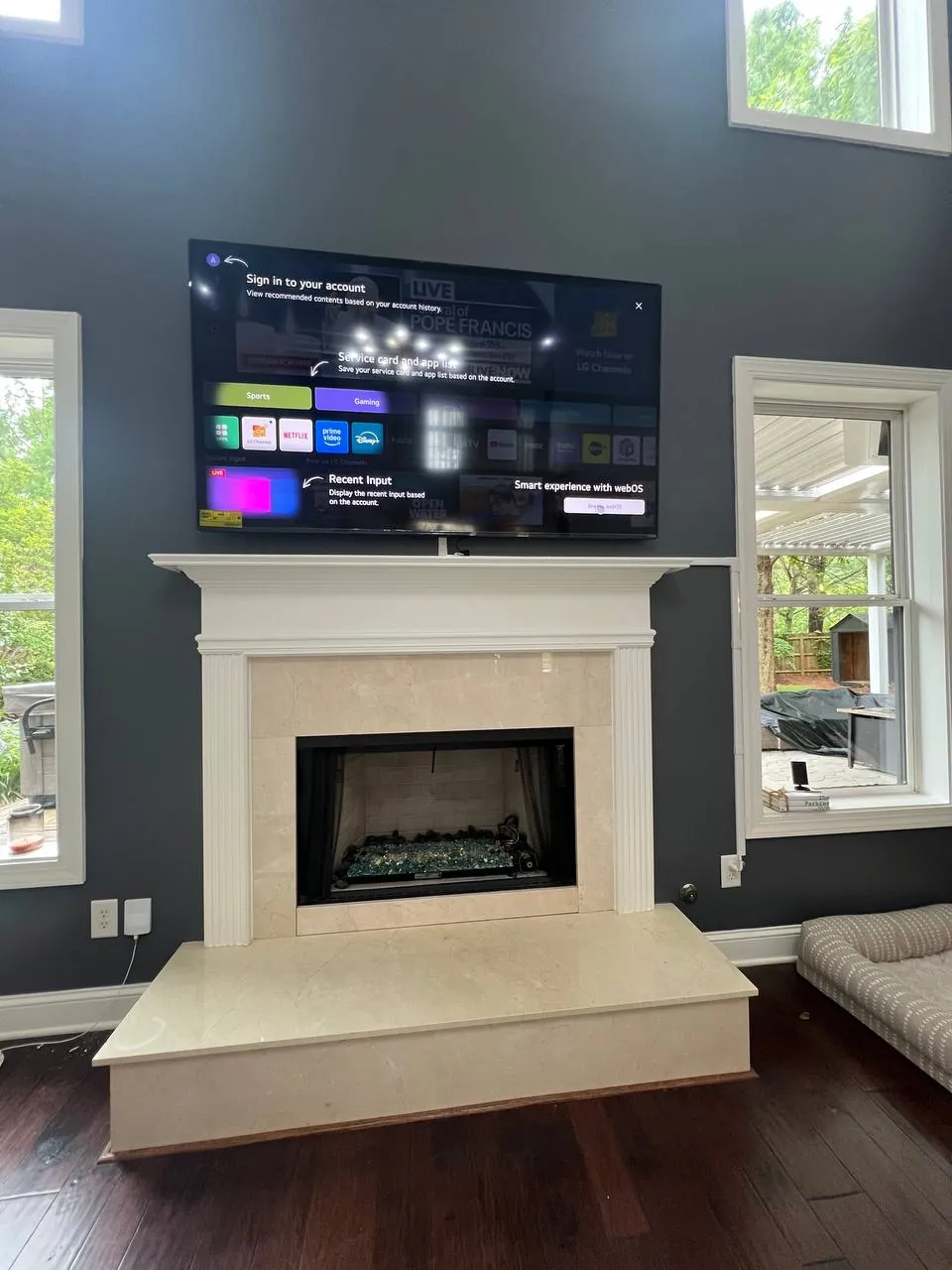
A TV can go above a fireplace when the wall at bracket height stays inside the operating temperature range printed in the TV’s manual, the mantel lets the screen sit low enough to watch without craning, and the mount tilts the picture down toward the seats. Get those three right and the rest is a price list: the labor for the TV’s size, $49 for mounting above a fireplace, the mount, the wall and the wires. A 65-inch TV on a tilting mount above a drywall fireplace with the cords showing comes to $273. This guide takes the decisions in the order you meet them.
Heat: test the wall before you commit
The question is how warm the wall gets at the height where the back of the TV would hang, after the fire has run the way you normally use it.
Run the fireplace for half an hour as you would on an ordinary evening. Then put your palm flat on the wall at the spot the bracket would sit, and again a foot higher, where the top of the screen would be. If you want a number instead of a feeling, a stick-on thermometer, or a cheap infrared one pointed at the wall, gives you one in a few seconds.
TV makers publish an operating temperature range in the manual, and it varies by model. The wall at bracket height should stay inside that range while the fire is on.
Two things change the result. A mantel that projects out from the wall pushes the rising heat forward and up into the room, so the wall above a deep shelf often stays cooler than the wall above a shallow one or no mantel at all. The fuel matters too: an open wood fire sends the most heat up the face, a gas insert with a sealed front usually sends less, and an electric fireplace puts little heat into the wall. A fireplace that is never lit is a wall with a shelf on it.
Height: as low as the mantel allows
On an ordinary wall the aim is to put the center of the screen close to your eye level when seated. Above a fireplace that is almost never possible, because the mantel is in the way. The aim shifts to the lowest height the mantel and the heat test allow.
Measure from the floor to the top of the mantel shelf. Add the gap you want between the shelf and the bottom of the TV, enough to clear anything you keep on the mantel and to let the screen tilt without touching the shelf. That is where the bottom edge of the TV goes, and the bracket is set from there. A technician marks that line on the wall with you before any hole is drilled, so you can check it from the couch first.
The mount: tilting, full motion or fixed
Above a mantel the usual answer is a tilting mount, $59. It holds the TV near the wall and angles the screen down a few degrees, which brings the picture back toward the couch and cuts glare from windows across the room.
A full-motion mount, $79, is the answer when the seating is off to one side, when the room is long and the fireplace sits at one end, or when you want to pull the TV down and out over the mantel for a movie and push it flat afterward. The trade is a thicker profile against the wall.
A fixed mount, $49, only makes sense above a fireplace when the mantel is low, so the screen already sits close to eye level and needs no angle. If you already own a mount, it goes up at no extra charge.
The wall: drywall or masonry
Many fireplace walls are drywall over wood framing, the same as the rest of the room, and the chimney is a chase of studs with the flue inside it. A mount there goes into the studs with lag bolts, and there is no wall charge.
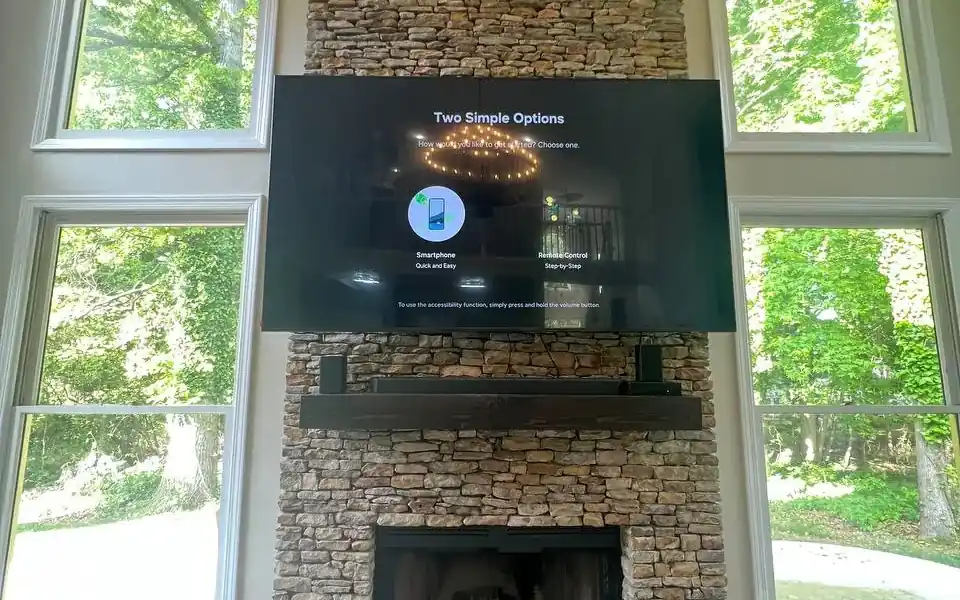
Brick, stacked stone, slate and tile are the $59 hard-wall line. The anchors change, the drill changes, and the time changes. Stacked stone is the slowest, because its face is uneven and the bracket has to be shimmed level across the high and low stones. The brick and stone page describes the anchors and what to expect from the drilling.
A photo from across the room, straight on, tells the technician most of what the visit will involve: whether the surround is masonry or painted drywall, how deep the mantel is, how tall the chimney wall runs, and where the nearest outlet sits. A second photo close up on the surface settles whether it is real stone or a veneer, which drills differently.
Wires above a fireplace
A paintable cover, $49, runs from the TV down the side of the fireplace to the nearest outlet. On brick or stone it is often the only tidy choice, since cutting a channel through masonry is not something a mounting visit includes.
Wires inside the wall with a power outlet behind the TV is $149 above a fireplace, against $99 on a plain wall. The difference is what sits behind the drywall. There is the firebox, which the wires must stay clear of. There is the extra framing that carries the chimney breast above it, often doubled headers and blocking that stop a fish tape cold. And in some houses the whole wall is a chimney chase, so the route has to come down beside it rather than through it. The wire concealment page covers both options on ordinary walls as well.
What the whole job costs
The fireplace itself is one line: $49 on top of the labor for the TV’s size, for any fireplace, electric included. It exists because the TV is lifted higher than on an ordinary wall and the height has to be worked out against the mantel.
Labor is $69 for a TV up to 31 inches, $129 from 32 to 59 inches, and for 60 inches and up either $165 with one technician and your help lifting or $210 with two technicians. Then add the mount if you need one, $59 for a hard wall, and the wire line you choose.
Three totals cover most fireplace rooms:
- A 65-inch TV on a tilting mount above a drywall fireplace, cords showing: $273. That is $165 for the size, $59 for the mount and $49 for the fireplace.
- The same TV and mount above a brick or stone fireplace, cords showing: $332, which adds the $59 hard-wall line.
- The same TV and mount above a drywall fireplace with the wires inside the wall and an outlet behind the TV: $422.
Every line is on the prices page, and the fireplace mounting page has the same menu with a price tool. Installation labor carries a one-year guarantee: if the install causes a problem in the first 12 months, it is fixed free.
Questions
Will the heat from my fireplace damage the TV?
Only if the wall at bracket height goes past the operating range in the TV’s manual while the fire is on. Run the fireplace for half an hour the way you normally use it and feel the wall, or read it with a stick-on or infrared thermometer. A projecting mantel, a gas insert or an electric fireplace each keep the wall cooler than an open wood fire does.
Why is there a fireplace charge when the wall is ordinary drywall?
Because the TV sits higher. Every fireplace install, electric ones included, means working from a ladder, setting the height against the mantel with you, and tilting the screen to suit the seat. That is the $49 fireplace line, and it is the only line a drywall fireplace adds when the cords stay in view.
Can the wires be hidden on a stone fireplace?
Usually in a cover, not in the wall. A paintable cover for $49 runs down the edge of the surround to the outlet and takes paint to match the trim. Cutting into stone to bury cable is not part of a mounting visit, so send a photo and the technician will say which route the surround allows.
How high is too high for a TV over a mantel?
There is no single number, because mantel heights and couch heights vary. The test is whether you can watch from your usual seat without tilting your head back, with the screen angled down on a tilting mount. If the mantel is so tall that the test fails, a smaller TV or a different wall is a better answer than a taller ladder.
Text a photo of the wall and the TV’s size to (404) 448-1471, add up your own setup on the prices page, or pick a time from the contact page.